
What Is Avogadro’s Number?
Avogadro’s number is 6.02214076×10²³, usually rounded to 6.022×10²³. It represents the number of particles — atoms, molecules, ions, or any other chemical unit — contained in exactly one mole of a substance.
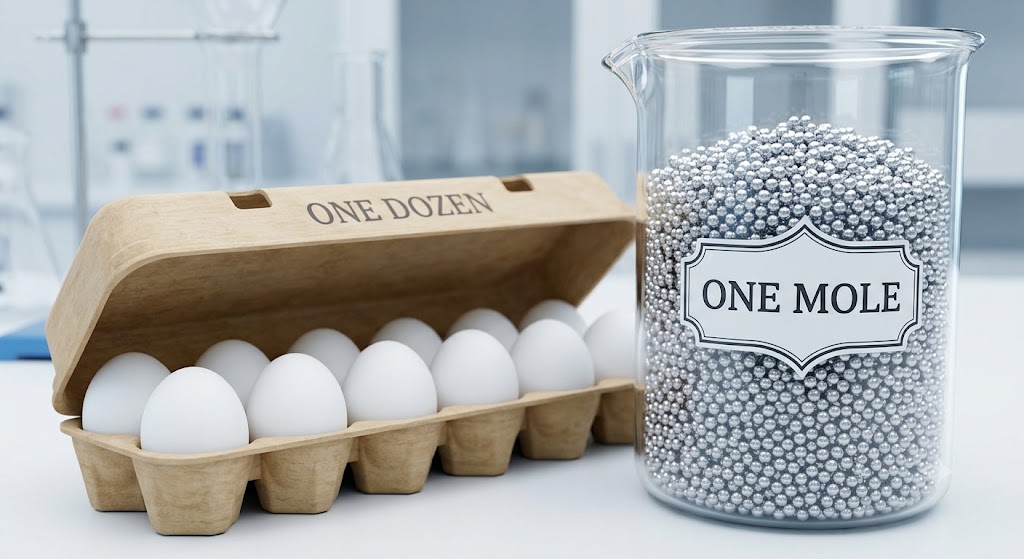
Think of it this way. Just as a “dozen” always means 12 eggs, a “mole” always means 6.022×10²³ particles. The word “mole” (from the Latin moles, meaning mass or pile) is simply a counting unit for extraordinarily small things. Since atoms and molecules are too small to count individually, chemists group them into this fixed, enormous quantity.
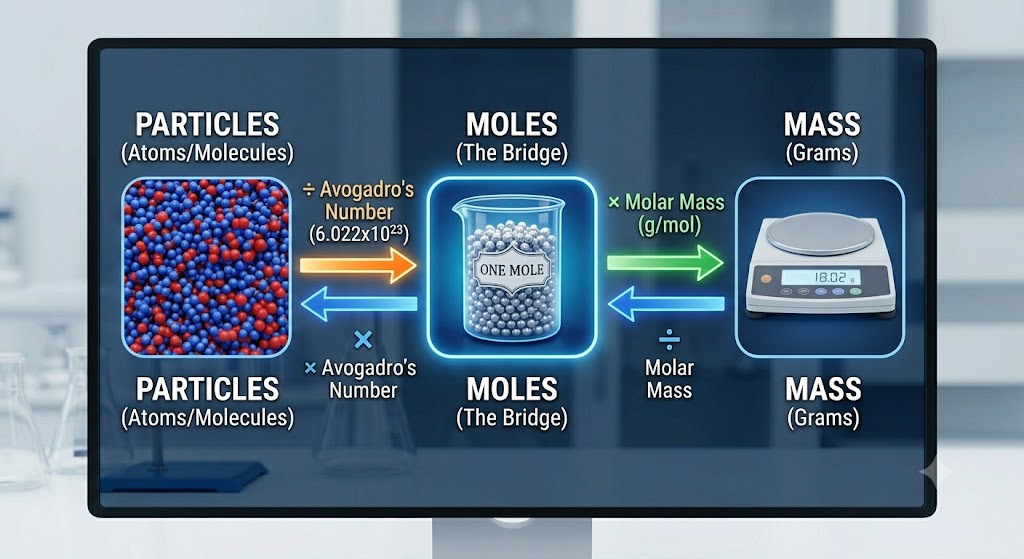
The official name is Avogadro’s constant, given the symbol Nₐ or L. Its SI unit is mol⁻¹ (per mole), making it a bridge between the atomic world and the macroscopic world you can weigh on a balance.
How Big Is 6.022×10²³? A Sense of Scale
Numbers this large are genuinely difficult to visualise. Here are a few comparisons that make it concrete:
Grains of sand on Earth: Scientists estimate roughly 7.5×10¹⁸ grains of sand on all beaches worldwide. Avogadro’s number is about 80,000 times larger than that.
Stars in the observable universe: Astronomers estimate around 10²⁴ stars in the observable universe — only about 1.7 times bigger than Avogadro’s number. One mole of anything is comparable to the number of stars in the universe.
Seconds since the Big Bang: The universe is approximately 13.8 billion years old, which is about 4.35×10¹⁷ seconds. Avogadro’s number is more than a million times larger.
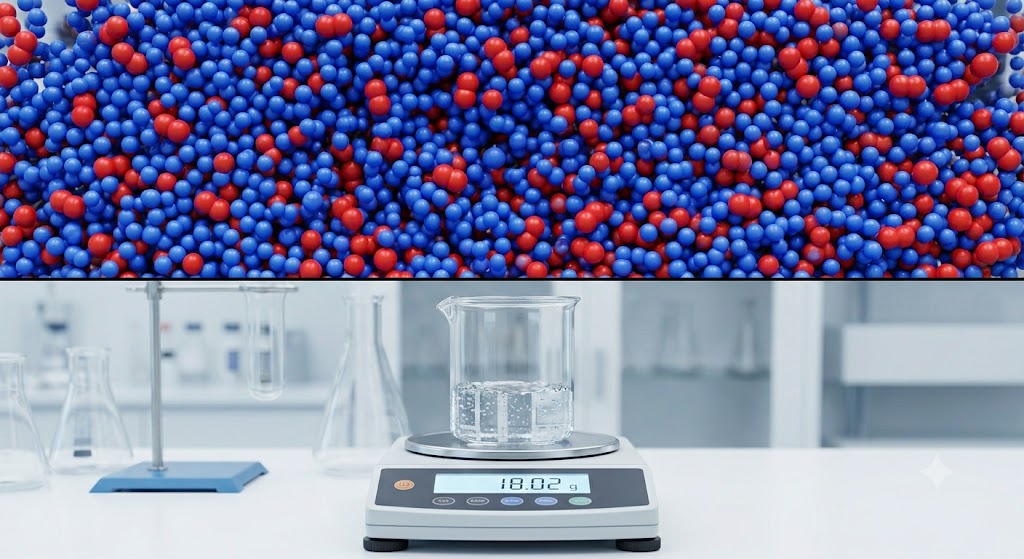
Mole of water molecules: One mole of water (18 grams — a small sip) contains 6.022×10²³ individual H₂O molecules. Each molecule consists of two hydrogen atoms and one oxygen atom, giving you about 1.8×10²⁴ total atoms in that single sip.
Where Does Avogadro’s Number Come From?
The constant is named after Italian scientist Amedeo Avogadro (1776–1856), who proposed in 1811 that equal volumes of gases at the same temperature and pressure contain the same number of molecules — now known as Avogadro’s Law. However, Avogadro himself never calculated the actual number. That came later.
The value was first estimated accurately by Josef Loschmidt in 1865, who calculated the number of molecules in one cubic centimetre of gas. The modern precise value was determined through several independent experimental methods:
X-ray crystallography: Measuring the spacing between atoms in a crystal lattice, then calculating how many fit in a known volume and mass.
Millikan oil drop experiment: Measuring the charge of a single electron, then dividing the Faraday constant (charge per mole of electrons) by the electron charge to get Nₐ.
Brownian motion: Einstein’s 1905 mathematical analysis of Brownian motion allowed Perrin to experimentally determine Nₐ in 1909, earning him a Nobel Prize.
Since 2019, the mole has been officially redefined in the SI system. Rather than being derived from other units, Avogadro’s constant is now exactly 6.02214076×10²³ mol⁻¹ by definition — one of seven defining constants of the SI system.
Why Chemists Need Avogadro’s Number
The core problem Avogadro’s number solves is this: atoms are real and have real masses, but those masses are incomprehensibly tiny. A single carbon-12 atom weighs 1.993×10⁻²³ grams. You cannot weigh that on any laboratory balance. But you can weigh 12 grams of carbon — and that 12 grams contains exactly 6.022×10²³ carbon atoms.
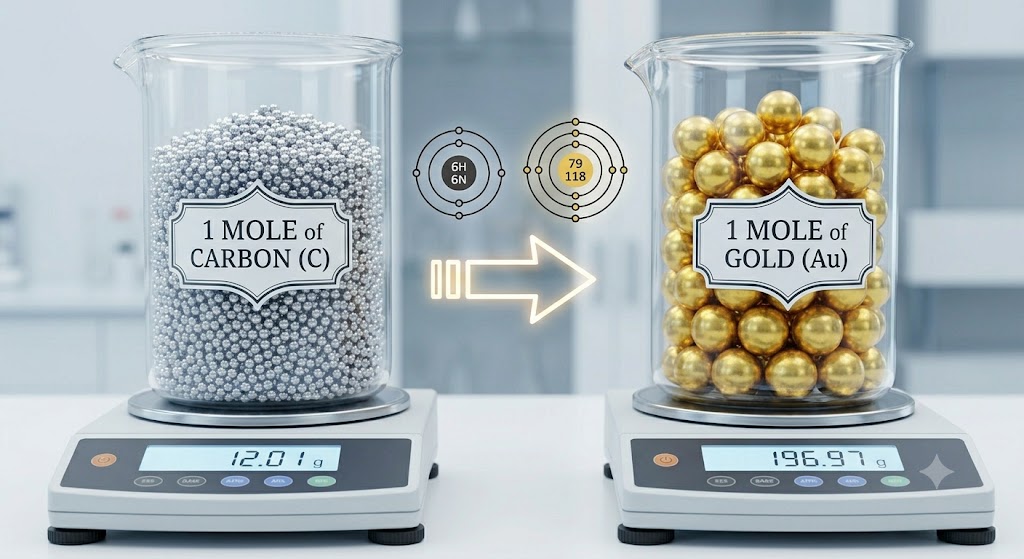
This is the definition of the mole: one mole of carbon-12 atoms has a mass of exactly 12 grams. The molar mass (in grams per mole) of any element is numerically equal to its atomic mass (in atomic mass units, or amu). This is not a coincidence — it is by design.
So Avogadro’s number is the conversion factor between two worlds:
- The atomic world: masses measured in amu, counts in individual atoms
- The macroscopic world: masses measured in grams, quantities measured in moles
Without this bridge, chemistry as a practical science would be impossible. You could not calculate how much product a reaction produces, how to make a solution of a specific concentration, or how many molecules react in a given experiment.
How to Use Avogadro’s Number — Step-by-Step Calculations
Converting Moles to Number of Particles
Formula: Number of particles = moles × Nₐ
Example: How many molecules are in 2.5 moles of water (H₂O)?
- Identify the formula: particles = moles × 6.022×10²³
- Substitute: particles = 2.5 × 6.022×10²³
- Calculate: particles = 1.506×10²⁴ molecules
Converting Number of Particles to Moles
Formula: Moles = number of particles ÷ Nₐ
Example: A sample contains 1.806×10²⁴ atoms of sodium (Na). How many moles is that?
- Formula: moles = particles ÷ 6.022×10²³
- Substitute: moles = 1.806×10²⁴ ÷ 6.022×10²³
- Calculate: moles = 3.0 moles of sodium
Converting Grams to Moles Using Molar Mass
Formula: Moles = mass (g) ÷ molar mass (g/mol)
Example: How many moles are in 54 grams of water? (Molar mass of H₂O = 18.015 g/mol)
- Moles = 54 ÷ 18.015
- Moles = 3.0 mol
- Number of molecules = 3.0 × 6.022×10²³ = 1.807×10²⁴ molecules
Use our Grams to Moles Calculator to do this instantly for any element or compound.
Converting Grams to Number of Atoms (Three-Step Chain)
Example: How many atoms are in 12 grams of carbon? (Molar mass of C = 12.011 g/mol)
- Convert grams to moles: 12 ÷ 12.011 = 0.9991 mol ≈ 1.000 mol
- Convert moles to atoms: 1.000 × 6.022×10²³
- Result: 6.022×10²³ atoms — this is exactly one mole ✓
This three-step chain (grams → moles → particles) is the foundation of nearly every stoichiometry calculation in chemistry.
Avogadro’s Number and Molar Mass — The Connection
Every element on the periodic table has an atomic mass listed in amu. By the definition of the mole, that same number in grams contains exactly one mole of atoms. This gives us molar mass:
| Element | Atomic Mass (amu) | Molar Mass (g/mol) | Atoms in 1 mole |
|---|---|---|---|
| Hydrogen (H) | 1.008 | 1.008 g/mol | 6.022×10²³ |
| Carbon (C) | 12.011 | 12.011 g/mol | 6.022×10²³ |
| Oxygen (O) | 15.999 | 15.999 g/mol | 6.022×10²³ |
| Iron (Fe) | 55.845 | 55.845 g/mol | 6.022×10²³ |
| Gold (Au) | 196.967 | 196.967 g/mol | 6.022×10²³ |
Notice: every element contains the same number of atoms per mole. The molar mass simply tells you how many grams that mole weighs. Iron atoms are about 56 times heavier than hydrogen atoms — so 56 grams of iron and 1 gram of hydrogen each contain the same 6.022×10²³ atoms.
For compounds, add up the molar masses of all atoms in the formula. Water (H₂O) = 2×1.008 + 15.999 = 18.015 g/mol.
Common Mistakes When Using Avogadro’s Number
Mistake 1 — Confusing atoms and molecules: One mole of H₂ gas contains 6.022×10²³ molecules, but 2×6.022×10²³ = 1.204×10²⁴ atoms (since each molecule has two atoms). Always clarify which particle you are counting.
Mistake 2 — Forgetting to find molar mass first: You cannot convert grams to atoms in one step. The chain is always: grams ÷ molar mass = moles → moles × Nₐ = particles.
Mistake 3 — Using the wrong value: Some problems use 6.02×10²³ (3 sig figs), others use 6.022×10²³ (4 sig figs). Use the precision that matches your other data. The exact SI value is 6.02214076×10²³.
Mistake 4 — Treating molar mass as a count: Molar mass is mass per mole (g/mol), not a number of atoms. Carbon’s molar mass of 12.011 g/mol means 12.011 grams per mole — not 12 atoms.
Real-World Applications of Avogadro’s Number
Pharmaceutical dosing: Drug manufacturers calculate doses at the molecular level. Knowing that 500 mg of aspirin (molar mass 180.16 g/mol) contains 500/1000/180.16 × 6.022×10²³ = 1.67×10²¹ molecules of aspirin allows chemists to predict exact therapeutic effects.
Industrial chemistry: Chemical plants need precise mole ratios to ensure complete reactions and minimise waste. Avogadro’s number is embedded in every yield and purity calculation.
Materials science: The number of atoms per unit cell in a crystal determines its density. Knowing Nₐ lets materials scientists calculate theoretical density from crystal structure alone.
Nuclear physics: Radioactive decay rates are calculated per mole of material. The number of atoms present — directly from Avogadro’s number — determines how radioactive a sample is.
Frequently Asked Questions
Q: What exactly is Avogadro’s number?
A: Avogadro’s number (6.02214076×10²³) is the number of particles in one mole of any substance. It is the bridge between atomic mass units and grams, making laboratory-scale chemistry possible.
Q: Why is Avogadro’s number so large?
A: Because atoms are extraordinarily small. A single hydrogen atom has a mass of 1.67×10⁻²⁴ grams. To get a measurable gram of hydrogen you need 6.022×10²³ of them. The number is large because atoms are small.
Q: Who actually calculated Avogadro’s number?
A: Despite being named after Amedeo Avogadro, he never calculated the value himself. Jean Baptiste Perrin made the first reliable experimental determination in 1909, winning the Nobel Prize in 1926 for this work.
Q: What is the difference between Avogadro’s number and Avogadro’s constant?
A: They are almost the same thing. Avogadro’s number (6.022×10²³) is a dimensionless count. Avogadro’s constant (Nₐ = 6.022×10²³ mol⁻¹) is the same value with units of per mole, making it a true physical constant with dimensional analysis.
Q: Does Avogadro’s number apply to everything?
A: Yes — one mole of anything contains 6.022×10²³ of that thing. One mole of elephants would be 6.022×10²³ elephants. In practice it is only useful for atoms and molecules because those are the only things small enough to need such large counting numbers.
Want to Calculate This Instantly?
Instead of doing the conversion chain manually, our Grams to Moles Calculator handles every step automatically — enter a mass and a chemical formula, and it calculates moles, number of atoms or molecules, and molar mass with full working shown. For solution chemistry, the Molarity Calculator uses mole calculations to find concentration, volume, and moles of solute for any solution.
Related Calculators
- Grams to Moles Calculator — Convert any mass to moles instantly
- Molarity Calculator — Moles in solution: concentration, volume, moles
- Percent Composition Calculator — Find the percentage by mass of each element
- Empirical Formula Calculator — From percent composition to formula
- Significant Figures Calculator — Round your answers correctly
Sources & References
- Avogadro constant exact value NA = 6.02214076×10²³ mol⁻¹: CODATA 2018, NIST SP 961. physics.nist.gov
- 2019 SI redefinition fixing Avogadro’s constant exactly: BIPM SI Brochure, 9th edition (2019). bipm.org
- Mole concept and stoichiometry: Brown, T.L. et al. (2018). Chemistry: The Central Science, 14th ed. Pearson. Chapter 3.
- Historical determination of Avogadro’s number by X-ray crystallography: Millikan, R.A. (1917). “A new determination of e, N, and related constants.” Philosophical Magazine 34: 1–30.
- OpenStax Chemistry 2e (CC-BY 4.0), Chapter 3.1 — Formula Mass and the Mole Concept. openstax.org

